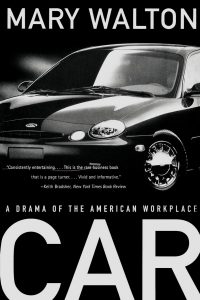
In a recent Jalopnik article, auto journalist Elizabeth Blackstock poses a question to her reading audience. When she asks, ‘what’s your favorite car book?’, Blackstock is looking for reading material that has changed an individual’s perspective of a car, or altered his or her perception of the auto industry. Blackstock’s question led me back to my days in graduate school when I selected Car: A Drama of the American Workplace to review as an assignment. Mary Walton’s book – a first-hand account of the 1996 Ford Tauras development and launch – was both educational and illuminative. Written in 1997, Car offers an inside look into an industry that was, at the time, struggling for survival. For those who have an interest in the inner workings of the auto industry in a particular moment in time, I offer my slightly updated review of Mary Walton’s Car for your edification and enjoyment.
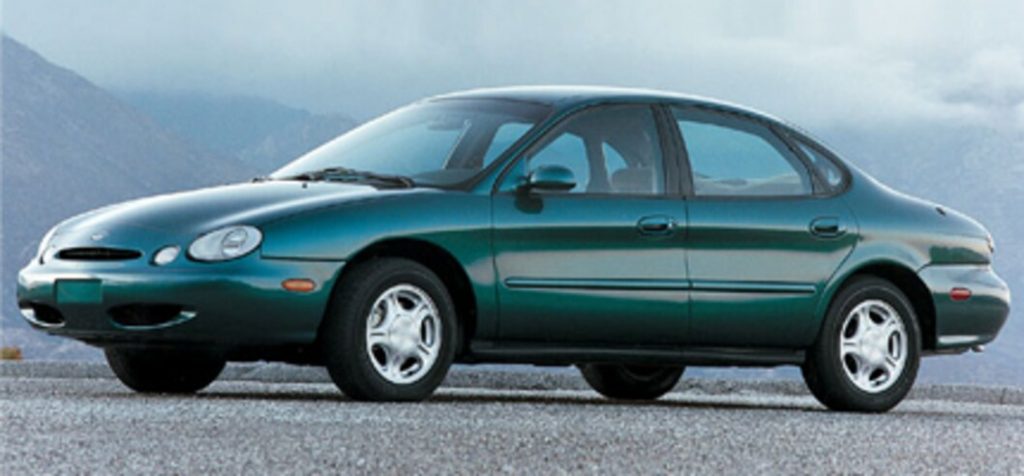
Car: A Drama of the American Workplace, written by Mary Walton, follows the lifecycle of an American automobile, the 1996 Ford Taurus, from conception to production to purchase. Walton, a veteran journalist, was provided with unprecedented access into the inner sanctum of the Ford Motor Company for this assignment. For three years, Walton became a part of the Taurus team, as designers and engineers, planners and analysts, and manufacturing and product managers worked diligently and ceaselessly to develop “The Car That Would Save Ford.” In her reporting and analysis, Walton is both critical and kind. Over the course of the Taurus launch, she develops respect and affinity for the individuals she encounters, yet rarely allows those relationships to get in the way of objectivity. For those unfamiliar with the auto industry, Walton offers remarkable insight into the problems and obstacles that plague American car companies. At a point in history when American automobile manufacturers were in danger of going out of business, Walton’s insightful examination not only uncovers weaknesses and vulnerabilities within Ford, but also identifies possible contributors to the impending industry collapse.
The Ford Motor Company has a long and determined history. Its founder, Henry Ford, was an individual who found change difficult, so much so that he built the same car, the Model T, for nearly 20 years. This ideological resistance to change, Walton discovers, is endemic within the current Ford corporate culture. Invention and innovation, in both product and policy, are most often met with apprehension and obstinacy. As Walton astutely observes, the failure to think “outside the box,” to take chances, makes it extremely difficult, if not impossible, for an automobile company such as Ford to stake a claim as an industry leader. The redesign and reinvention of the 1996 Taurus presented the possibility of such a position. However, the goal of the Taurus team was never to create a great new car, but rather, to “beat Camry.” It was not to build a better vehicle for its own sake, but to build one equal to or better than a vehicle, the Toyota Camry, that already existed. As Car suggests, developing new products in this manner situates Ford as a competitor rather than a leader. Building a car as a response rather than an introduction guarantees that Ford is always playing catch-up, with the consequence that the company is continually years behind its closest competitor in product design and development.
Walton also paints a revealing portrait of Ford management, a bureaucratic structure of almost unfathomable proportions. It is a complicated, multi-level system that not only stifles creative thinking, but also creates an atmosphere of intimidation and fear among the rank and file. There are so many approval layers that decisions made by lower echelons may reach the top only to be arbitrarily dismissed by those in power. Superiors often have little knowledge of the factors that went into such decisions, yet possess the ability to change or kill a concept at will. Walton also observes a culture in which white-collar workers are held hostage by an entrenched corporate promotion system based on job level categories. Ambitious Ford employees will do just about anything to rise through the ranks of this elaborate system, and fear staying at any level for too long a period. There is a tremendous amount of competition for promotions, and “rocking the boat” most often decreases an individual’s chance of advancement. Thus individuals are uneasy speaking up to or disagreeing with those in authority. As Walton writes, “the higher you went up the executive ladder, the less people spoke out.” Dick Landgraff, the head engineer on the Taurus project, was often “frustrated by how hard it was to find out what colleagues really thought” (87).
Walton describes a white-collar atmosphere in which every aspect of a project is discussed ad infinitum. She remarks, “one of the problems at Ford, one of the many problems at Ford, was that people were afraid to be specific, to make commitments, because they might get nailed if things went awry” (46). Ford engineers and designers often spent more time in meetings than actually working on projects. Walton relates the story of management consultant hired by Ford, who attended seven meetings totaling twelve hours in length. She remarks, “He counted 155 people and one decision. This means 155 people spent 11 hours ‘sharing information’”(146). The time spent in meetings not only causes individuals to lose focus on the project at hand, but it also exponentially increases the time from concept to completion. While the Japanese are able to get an automobile to market in just over two years, it takes Ford almost five to complete the same process. It is difficult, if not impossible, to predict the preferences of the American car buying public five years in advance. Automobiles developed in such an extended time frame are often out of date before they reach the public. As Landgraff remarked to Walton, “if the Taurus were going to save Western democracy, the war would have been over by the time we got it on the street” (118).
However, perhaps the most lasting and illuminating impression Walton provides in Car is of a company that has lost its way. The endless meetings, strict hierarchy, inability to make decisions and fear of innovation reveal a corporation unclear of its identity and direction heading into the twenty-first century. The redesign of the 1996 Taurus was undertaken with the goal of meeting or exceeding the success of the original version, which had been the best-selling car in America in 1992. Yet as Walton discloses, “the amazing truth was that Ford never quite understood precisely how or why it had scored with the original Taurus” (52). To achieve success with the redesigned Taurus, Ford believed it was imperative to attract the import buyer rather than expand its own customer base. Yet Ford misunderstood its target, defining the new Taurus customer as the former “varsity football player and his cheerleader wife,” a family configuration more reflective of the 1950s than the upcoming millennium. As a consequence, the new Taurus appealed to no one, not the import buyer nor the traditional Ford customer. As Walton notes after the Taurus introduction, “the press was saying, after a fashion, that the car was too good” (343). Body engineers such as Steve Kozak detected the implication that “Ford had done something almost un-American by elevating ‘America’s car’ beyond the reach of the guys with blue collars” (343). Rather than develop a car to please the American car buyer, Ford’s goal was to out-Japanese the Japanese. The result was a car that cost more than the Camry, making it inaccessible to the average Ford customer, yet with limited appeal to import buyers. Walton adds, “during the four-year journey from Dearborn to dealers, the market had shifted,” a trend noted by the manufacturers of the Camry. In 1996, the year of the new Taurus, a redesigned Camry debuted with “conservative styling, fewer niceties, and lower prices than the previous model.” Unlike the Ford Motor Company, Walton tells us, “ever-vigilant Toyota had responded to the latest market shift” (347). In 1996, the Camry became the number one car in its class; the Taurus finished a distant third.
When Mary Walton was granted permission to document the development of the 1996 Taurus, she couldn’t believe her good fortune. Yet as she remarks, “sadly, after reading the completed manuscript, Ford management came to regret having allowed a journalist such a candid look at its operations” (xi). The reaction to Car questions how Ford allowed Walton to infiltrate its headquarters in the first place. Perhaps gender played a role, as the presence of a female journalist was perceived as non-threatening to an overwhelmingly male, technologically driven constituency. Normally isolated and introverted, it is possible many of the engineers actually welcomed Walton’s intrusion and used the opportunity to open up to her. Walton’s lack of automotive expertise may have also worked to her advantage. Ford employees may have spoken freely because they assumed Walton would have difficulty understanding what they were talking about. Ford executives, individuals with considerable egos, may have felt themselves to be above reproach; thus their actions and motives would not be questioned nor referred to in a negative manner. It is also possible that Ford offered Walton unprecedented access because it believed that the Taurus was destined to become a remarkable success. Therefore, the book would paint a glowing picture of Ford and its ideology, personnel and structure.
Finally, perhaps Walton was welcomed for the simple reason that Ford believed if readers could understand what really went on behind its famed glass walls, the image of the corporation would rise considerably in the public imagination. While ultimately such a goal was not achieved, Mary Walton provides an intriguing and enlightened look at the inner workings of an American car company. And while it was written over 25 years ago, Car: A Drama of the American Workplace, provides important and relevant insight into the problems and obstacles that faced Ford, as well as General Motors and Chrysler, at the dawn of the twenty-first century.