In a recent New York Times opinion feature, filmmaker Eve Van Dyke reflects on her own family car accident to explore the inequities in car design that negatively affect women. The realization that she and her boyfriend’s mother sustained more severe injuries than the men in the car prompted her investigation into gender bias in automotive safety design. In ‘Buckle Up, Cars Still Aren’t Built for You,’ Van Dyke argues that modern automobile safety systems continue to prioritize male bodies, leaving women disproportionately vulnerable in crashes.
For decades, notes Van Dyke, crash-test standards have relied almost exclusively on dummies modeled after the ‘average’ male body. Although some car manufacturers claim to use female dummies in testing, those models are most often scaled down versions of male bodies – often mimicking that of a 12-year-old boy – that do not reflect the distinct differences in women’s anatomy, muscle distribution, bone density, and seating posture. As a result, women in the United States are significantly more likely to suffer severe injury or death in comparable crashes.
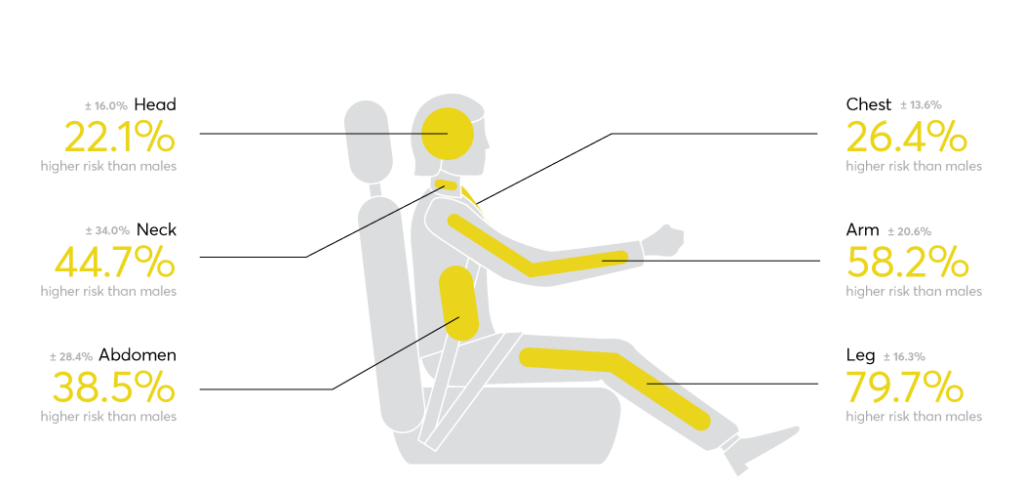
This problem, Van Dyke asserts, exists within a broader history of systems and technologies designed around male norms. For the past century, despite women constituting over 50% of car buyers and drivers, the automotive industry has treated male physiology as the default standard. The tendency to use the male body as the norm is not limited to automotive; for years medicine, engineering, and industrial design have maintained similar practices. [Until the late 1980s, for example, cardiovascular clinical trials almost exclusively used male subjects, meaning that heart disease symptoms, diagnoses, and treatments were largely based only on men.]
As someone who worked in the periphery of the auto industry, the refusal to consider female anatomy in automotive design was not news to me. It was also not a surprise to those who posted in the article’s comment section; women, particularly those of short stature like myself, spoke of the lifetime difficulties they have encountered adjusting cars to fit their small frames. As the majority of responders noted, the positioning of seatbelts, headrests, and steering wheels in American automobiles makes it almost impossible for a woman to sit comfortably and safely in the driver’s seat. As one contributor wrote, “I’ve often thought about this issue as my head’s point of impact against the headrest – no matter how I adjust it – is somehow so high that I’m sure my neck would break if I was ever rear ended.” Another exclaimed, “my particular nemesis is the seatbelt that crosses so close to your neck. I’m 5’2”. I’ve spent years driving/riding with one hand holding my seatbelt so it’s not against my neck.” These concerns mirror my own. In most cars the headrest, even at its lowest point, is too high to be effective; consequently I sit forward rather than rest my head against it. And I recall that when harness seatbelts were introduced, I spent the first few years after refusing to use them as the position of the top strap nearly choked me. One of the solutions the women mention, which I have written about previously, is to purchase a car that simply fits better. Women were the first to switch to Japanese imports for this reason; I myself have always found small German cars to be more suitable to my short body.
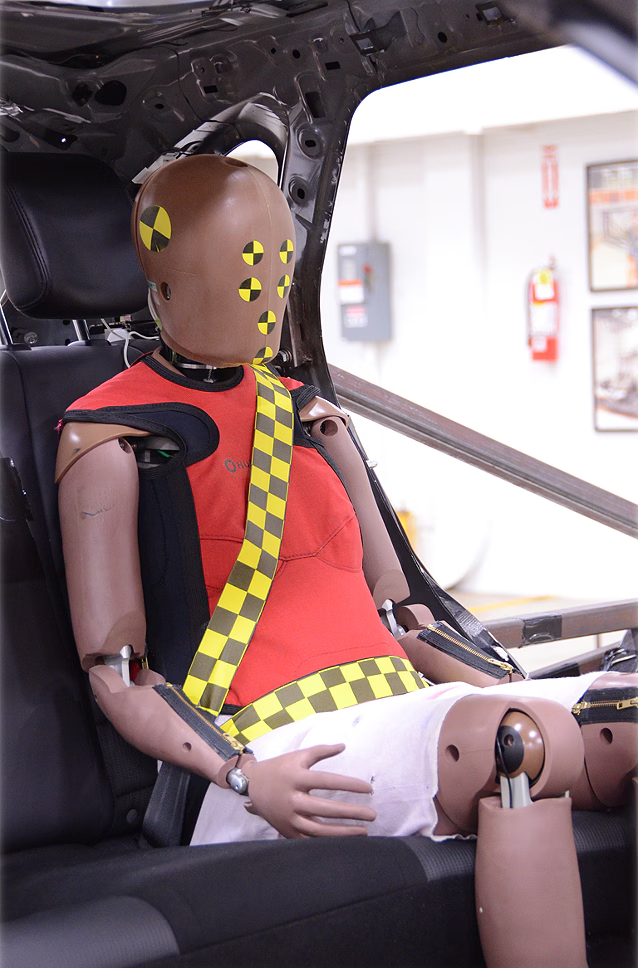
Although Van Dyke calls attention to ongoing efforts to improve safety testing, including the development of more sophisticated female crash-test dummies [such as the Thor 5-F], and legislative proposals such as the She Drives Act, car companies have been slow to respond. And even though the head of NHTSA [National Highway and Traffic Safety Administration] gave his support for the Thor 5-F, as of March 2026 there has been no deadline for implementation established, nor has there been any tangible action taken to incorporate such changes. Autoblog recently reported that some car manufacturers are deliberately settling for lower safety ratings in order to keep costs down, which is certainly a factor in the reluctance to implement increased safety measures for female drivers. Consequently, the standard for crash-test dummies, and automotive safety, remains disadvantageous, if not dangerous, for women behind the wheel.
Van Dyke is wise to bring attention to this matter. As she notes, automotive safety is both a technological and social justice issue; consequently, women’s bodies should not be treated as secondary in transportation design. This NYT story – as well as automotive accident and fatality statistics – demonstrate that car safety inequities are not accidental, but are the product of historical design choices and regulatory neglect. As the auto industry and the government seem to be unresponsive to this issue, it falls to those most affected by gender inequities in automotive safety – namely women – to influence change through advocacy, research, leadership, consumer pressure, and public engagement. Women are not dummies. They directly purchase over 60% of new vehicles in the US and influence over 85% of car buying decisions. It’s past time to consider women’s lives in the design of automobiles.
