A Street by Any Other Name.

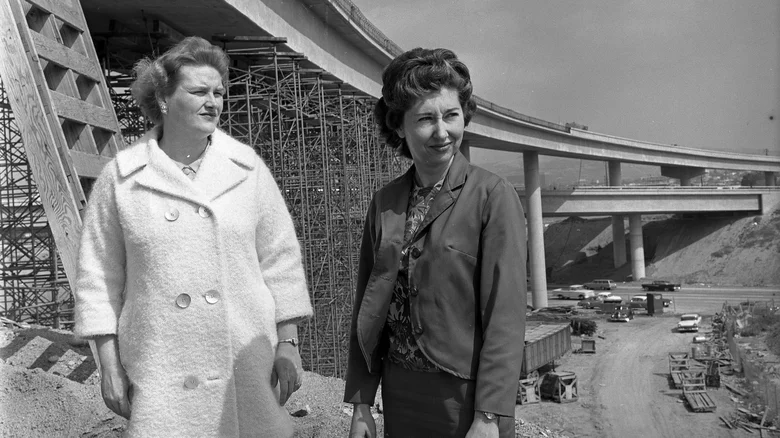
Jalopnik, a news and opinion website about cars, the automotive industry, racing, transportation, technology, motorcycles, and much more, recently published an article which delved into the woman whose name graces the 10 and 405 interchange in Los Angeles, California. Marilyn Jorgenson Reece was a woman of firsts. She was the first woman in California to hold a full civil engineering license, the first female resident engineer of the California Division of Highways, and the first woman assigned to design an interchange in the state. The interchange design, notes Jalopnik, was far from straightforward; “it required handling one of the most congested junctions in a city already defined by its freeways, while accommodating vehicles moving at sustained high speeds.” Female civil engineers were a rarity when Reece earned her degree from the University of Minnesota in 1948. My late aunt, who entered Southern Methodist University in 1942, was the only female in the school’s civil engineering program. Reece was rewarded for her breakthrough achievement, first by receiving the Governor’s Design Excellence Award in 1962, being recognized by the American Society of Civil Engineers as a lifetime member, and four years following her death in 2004, becoming memorialized in the dedication of the interchange in her name – the Marilyn Jorgensen Reece Memorial Interchange.
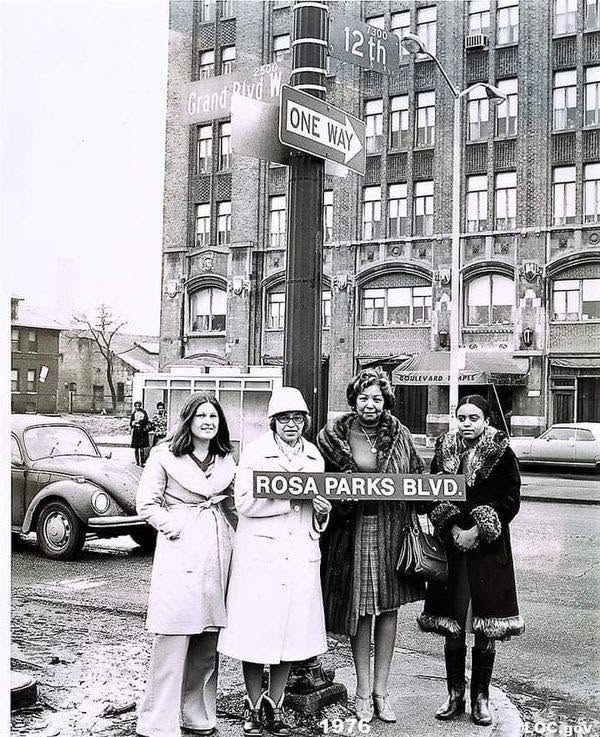
Detroit -1976: the renaming of 12th Street to Rosa Parks Boulevard [Ms. Parks second from left]

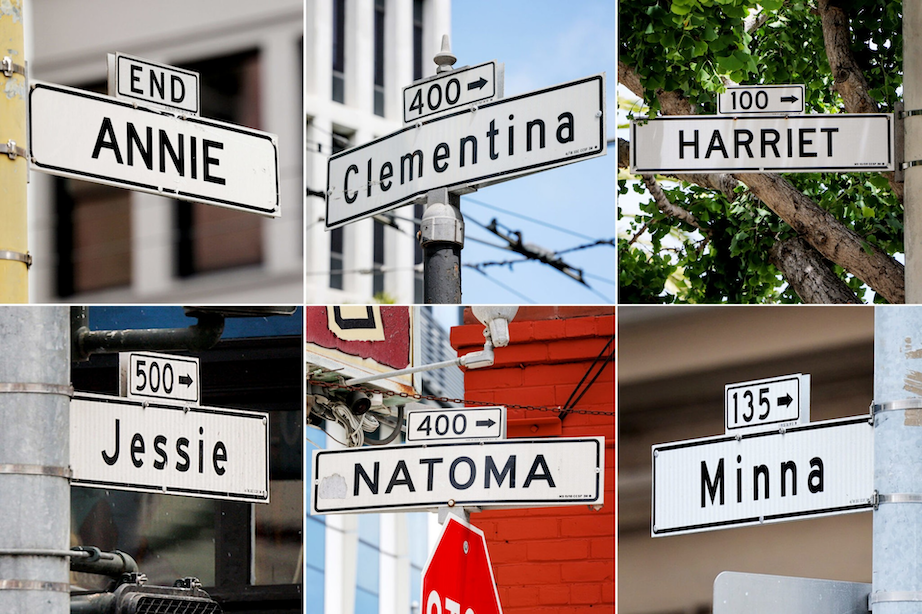
This news story was not only interesting for its attention to the significant but little-know accomplishments of a remarkable engineering pioneer, but it also got me to wondering how many other US interchanges, highways, and city streets were named after women. The answer, which was not unexpected, is very few. Nearly three quarters of US streets honor men. Thousands of streets across the country are named after George Washington, yet the person-title streets in major cities that recognize women is less than 10%. There are a number of reasons for this roadway gender gap. For most of American history, men held public office, real estate development roles, and leadership positions. When streets, subdivisions, and towns were platted, developers and male leaders typically honored male politicians, landowners, war heroes, or family members. Secondly, society has historically recorded and celebrated the public achievements, military service, and business success primarily of men. Women’s contributions – often rooted in domestic, community, or uncredited labor – were rarely deemed “monumental” by city planners and therefore not considered as street-naming possibilities. When women did get streets named after them, it was usually as the daughters, wives, or relatives of wealthy landowners or mayors rather than for independent public achievements. My current city of residence, Ann Arbor, Michigan, was named after the founder’s wife Ann, as was the street two blocks from my house. Interestingly, it is rumored that the high number of streets seemingly named for women in San Francisco – Clementina, Ramona, Mary, and Harriet – were named after hookers. Finally, most American street networks were laid out and named permanently by the mid-twentieth century – prior to the women’s movement’s efforts to recognize female contributions – locking in the patriarchal naming conventions of those decades. 
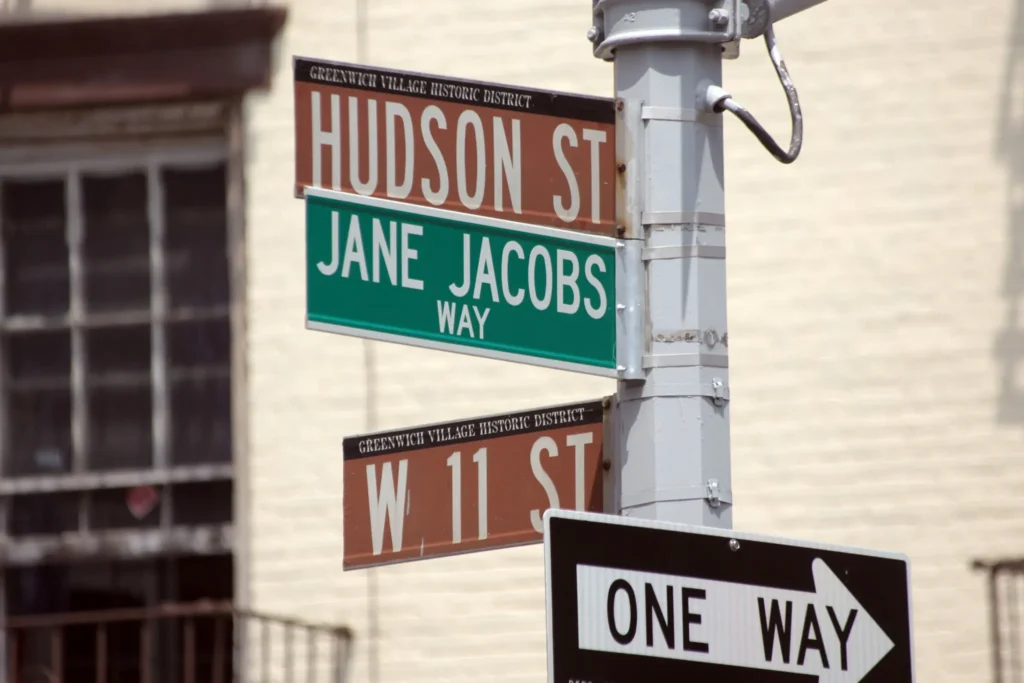
The objective of the Feminist Street Initiative, launched by the Women’s March Foundation on the fifth anniversary of the 2017 Women’s March, is to “reclaim our streets” and “rename streets across the United States to reflect the names of those women who have earned their place in history.” The individuals considered for recognition include feminist and historical icons Dolores Huerta, Gloria Steinem, Maya Angelou, Wilma Mankiller, Ruth Bader Ginsburg, and Sojourner Truth. In my own hometown of Detroit, Rosa Parks Boulevard is one of the only roads in the city [re]named for an influential woman. Los Angeles leads the way when it comes to streets that honor those who weren’t the wives or daughters of powerful men. No less than 30 LA thoroughfares recognize independent women who forged their own paths. Other cities – including New York and St. Louis – have named streets after historical female figures who fought for civil rights, science, or labor, as well as local pioneers or landowners who shaped their city’s history.
While it would appear difficult to name new streets or rename existing avenues to reflect the contributions of women after decades of male leadership, the Feminist Street Initiative website provides step-by-step guidance in the street naming process for those who seek to correct the gender imbalance on our nation’s roadways. The group also invites the public to contribute suggestions of noteworthy women for future street-naming initiatives.
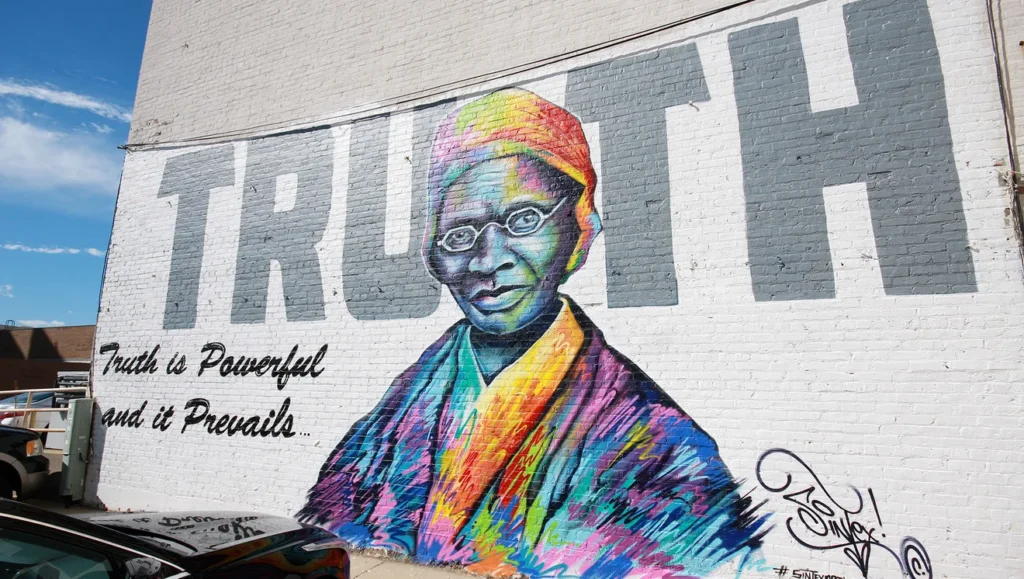
Sojourner Truth mural in Battle Creek, Michigan

The next time you drive one of the thousands of Washington boulevards, think of how much more interesting – and memorable – it would be to turn right on a street named Truth.
Ode to the Minivan

In 1983, Lee Iococca, and his team at Chrysler, introduced the roomy, reliable, safe, and ubiquitous minivan to the world. The production of the Dodge Grand Caravan and Plymouth Voyager not only saved the flailing automotive company, but in the process created a new vehicle category – the consummate family vehicle. As Cindy Donatelli argues, the timing of the minivan introduction coincided with Ronald Reagan’s “family values” campaign, often considered a backlash against the second-wave feminist visions of the 1960s and 1970s. As a “lifestyle enabler,”[1] the minivan – purposefully and aggressively identified with women by automakers, marketers, and the media – reinforced the notion that women bear primary responsibility for housework and childcare. As such, writes Donatelli, the minivan belongs to the nineteenth and twentieth century technological developments that “define domesticity as a female regime by identifying women, rather than men, with material objects and practices in the context of the home” (90).

In the election year of 1996, the ‘soccer mom’ became an important demographic category in American politics. While the term was most often called upon to define a particular white, middle-class, female suburban voter base, it was eventually appropriated into mainstream culture to describe a woman who devotes an inordinate amount of time transporting her school-age children to a myriad of sporting events and other activities. When pictured in the media, the soccer mom was invariably found behind the wheel of a minivan, crossover, or small SUV. As Donatelli suggests, the soccer mom phenomenon was the product of “an accidental convergence of vehicle choice, children, sport, and election year politics” (92). While women drivers have long been linked to a specific type of family vehicle – e.g. the station wagon of the 1950s and 1960s and the 1970s hatchback sedan – the soccer mom era forever cemented the notion of the “woman’s car” into the public consciousness. Sturdy, spacious, safe, and utilitarian, the “woman’s car” has become synonymous with a vehicle equipped especially for carrying kids and cargo.

During the time of the minivan’s introduction, I was working at an automotive advertising agency working on the Buick account. While I recognized the minivan’s value to a large segment of the US population, as a childless woman working to establish herself in a career populated by overtly conservative men, I distanced myself from the implications driving such a vehicle would generate. I vowed to never, ever, own a minivan, and was able to keep that promise to myself for a number of decades. Although, at this time, I began breeding and showing dogs, I looked pass the popular vehicle to consider other choices for hauling multiple, very large dogs. Under no circumstances did I want to be associated with a vehicle that Donatelli described as “the locus of daily family life,” even when that family was canine (89).

Flash forward 30 plus years and the conversation surrounding the minivan has greatly diminished. Its popularity has been overwhelmingly surpassed by that of the ubiquitous SUV. Although there are still remnants of its ‘mom car’ reputation remaining, advertising increasingly features dad behind the wheel, a positive and affirming move that suggests both parents are equally responsible for child rearing. 

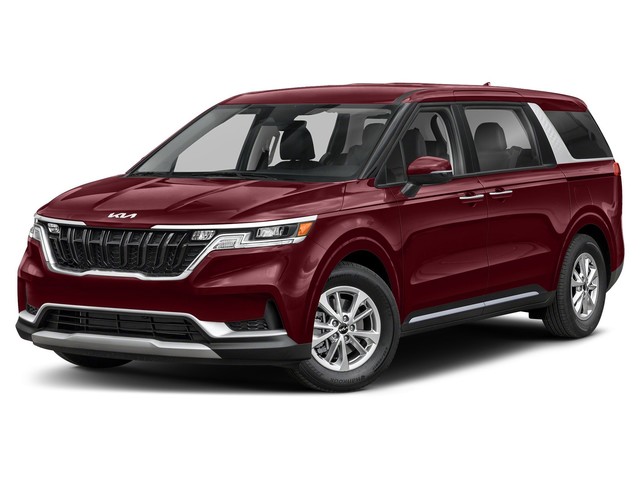
My own life has changed as well. No longer working as a full time professional, and no longer engaged in the dog show world, my dog hauling vehicle only has to accommodate two [still large] dogs. So a couple of years ago I did the unthinkable. I purchased one of the few minivans still on the market – a 2024 Kia Carnival.

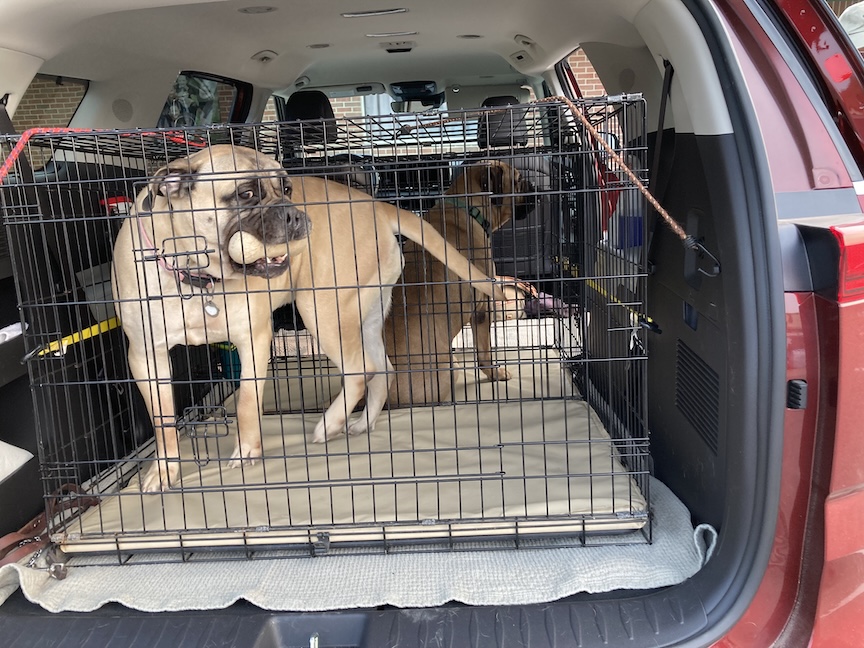
It was a carefully thought-out choice. I measured the rear door opening for its ability to accommodate side-by-side cargo crates. I chose a vehicle with rear seats that could be removed to provide a flat surface for those crates. As both the dogs and are getting older, the lower floor – particularly when compared to that of an SUV – made entering easier for my senior dogs as well as my aging self. 

A recent Edmunds.com article praised the Kia not because it’s cool [which it most definitely is not] but “because it’s so darn good at most everything you’d want it to be.” And as I discovered, that includes traveling with a couple of bullmastiffs. We recently took a road trip via Milwaukee [to visit my stepson] to Minnesota to take part in the annual family gathering at the Minnesota State Fair. Although the dogs were only with us for part of the way [they were dropped off at a friend’s boarding kennel in Kenosha] they were cool and comfortable for that leg of the trip. And so were we. Although I missed the power and performance of my Golf R, I-94 does not present many opportunities for quick acceleration [0 to 60 in 3.9 seconds] or tight cornering. The Kia describes itself as a multi-purpose vehicle [MPV], which perhaps suggests it is trying to “make you forget what you are driving.” While that is stretching reality just a bit, I have finally come to terms with the notion that one is not [always] what one drives. I am happy that the minivan continues to serve such an important function for families of all shapes and sizes. And I am glad that I have – at long last -gotten over my stubborn aversion to the minivan as a practical vehicle choice.


[1] Taken from a 1994 quote by Dick Johnson, former creative director at Chrysler ad agency BBDO, cited by Cindy Donatelli (88).

Donatelli, Cindy. “Driving the Suburbs: Minivans, Gender, and Family Values.” Material History Review 54 (2001): 84-95.